
Anatomy of Fire: Combustion & the Fire Tetrahedron
Combustion is the self-sustaining process of rapid oxidation of a fuel being reduced by an oxidizing agent along with the evolution of heat and light. Fires are defined by their physical characteristics. They may vary from very slow oxidation, as in rusting, to very fast oxidation, such as detonations and explosions. Somewhere between these extremes are the two most common reactions concerning firefighters: smoldering fires and flaming or free-burning fires.
For many years, the “fire triangle” (oxygen, fuel, and heat) was used to teach the components of fire. While this simple example is useful, it is not technically correct. For combustion to occur, four components are necessary:
- Oxygen (oxidizing agent)
- Fuel
- Heat
- Self-sustained chemical reaction (also referred to as the chain reaction)
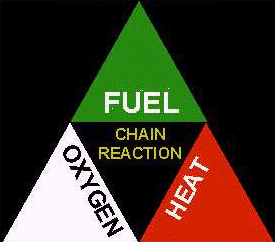
These components can be graphically described as the “fire tetrahedron”. Each component of the tetrahedron must be in place for combustion to occur. This concept is extremely important to fire suppression personnel. Remove any one of the four components and combustion will not occur. If ignition has already occurred, the fire is extinguished when one of the components is removed from the reaction.
Next: learn how each component works, starting with fuels and heat energy sources, then see how removing a component puts a fire out in extinguishment theory.