Free Fire Simulator — Firefighter Training Tools
The burning process occurs in clearly defined stages. By recognizing the different phases (or stages), a firefighter can better understand the process of burning and fighting the fire at different levels and with different tactics and tools. Each phase (or stage) is characterized by differences in room temperature and atmospheric composition. A firefighter may be confronted by one or all of the following three phases at any time.
🌱

Incipient Phase (Growth Stage)

In the first phase, the oxygen content in the air has not been significantly reduced and the fire is producing water vapor, carbon dioxide, perhaps a small quantity of sulfur dioxide, carbon monoxide and other gases. Some heat is being generated, and the amount will increase with the progress of the fire. The fire may be producing a flame temperature well above 1,000°F (537°C), yet the temperature in the room at this stage may be only slightly increased.

🔥

Free-Burning Phase (Fully Developed Stage)

The second phase of burning encompasses all of the free-burning activities of the fire. During this phase, oxygen-rich air is drawn into the flame as convection (the rise of heated gases) carries the heat to the uppermost regions of the confined area. The heated gases spread out laterally from the top downward, forcing the cooler air to seek lower levels, and eventually igniting all the combustible material in the upper levels of the room. This heated air is one of the reasons that firefighters are taught to keep low and use protective breathing equipment. One breath of this super-heated air can sear the lungs. At this point, the temperature in the upper regions can exceed 1,300°F (700°C).

As the fire progresses through the latter stages of this phase, it continues to consume the free oxygen until it reaches the point where there is insufficient oxygen to react with the fuel. The fire is then reduced to the smoldering phase and needs only a supply of oxygen to burn rapidly or explode.

🌫️

Smoldering Phase (Decay Stage)

In the third phase, flame may cease to exist if the area of confinement is sufficiently airtight. In this instance, burning is reduced to glowing embers. The room becomes completely filled with dense smoke and gases to the extent that it is forced from all cracks under pressure. The fire will continue to smolder, and the room will completely fill with dense smoke and gases of combustion at a temperature of well over 1,000°F (537°C).

The intense heat will have vaporized the lighter fuel fractions such as hydrogen and methane from the combustible material in the room. These fuel gases will be added to those produced by the fire and will further increase the hazard to the firefighter and create the possibility of a backdraft.

📈

Time-Temperature Curve

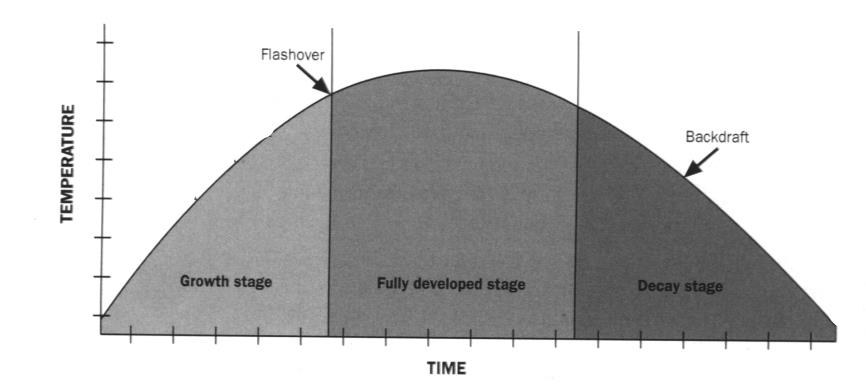
The demarcations between the three phases can be identified by a “time temperature curve”. During the incipient (or growth) phase of a fire, shown below as the upward curve, the time can vary depending on the type of fuel, the size of the room, and the amount of oxygen supplying the fire. Flashover occurs at the end of the incipient (or growth) phase and start of the free burning (or fully developed) stage. Backdraft can occur in the smoldering (or decay) phase.

Time-temperature curve showing growth, fully developed and decay stages of a fire
Time-temperature curve: flashover marks the end of the growth stage; backdraft can occur in the decay stage.
💥

Flashover

Flashover occurs when a room or other area becomes heated to the point where flames flash over the entire surface or area. Originally, it was believed that flashover was caused by combustible gases released during the early stages of fire. It was thought that these gases collected at the ceiling level and mixed with air until they reached their flammable range, then suddenly ignited causing flashover. It is now believed that while this may occur, it precedes flashover.

The cause of flashover is not attributed to the excessive build-up of heat from the fire itself. As the fire continues to burn, all the contents of the fire area are gradually heated to their ignition temperatures through “thermal radiation feedback”. When they reach this point, simultaneous ignition occurs and the area becomes fully involved in fire.

⚠️

Backdraft

Firefighters responding to a confined fire that is late in the free-burning phase or in the smoldering phase risk causing a backdraft or smoke explosion if the science of fire is not considered in opening the structure.

In the smoldering phase of a fire, burning is incomplete because not enough oxygen is available to sustain the fire. However, the heat from the free-burning phase remains, and the unburned carbon particles and other flammable products of combustion are just waiting to burst into rapid, almost instantaneous combustion when more oxygen is supplied. Proper ventilation releases smoke and the hot unburned gases from the upper areas of the room or structure. Improper ventilation at this time supplies the dangerous missing link — oxygen. As soon as the needed oxygen rushes in, the stalled combustion resumes, and it can be devastating in its speed, truly qualifying as an explosion.

Combustion is related to oxidation, and oxidation is a chemical reaction in which oxygen combines with other elements. Carbon is a naturally abundant element present in wood, among other things. When wood burns, carbon combines with oxygen to form carbon dioxide, or carbon monoxide, depending on the availability of oxygen. When oxygen is no longer available, free carbon is released in the smoke. A warning sign of possible backdraft is dense, black (carbon-filled) smoke.

Possible indicators of a backdraft or smoke explosion

  1. Smoke under pressure
  2. Black smoke becoming dense gray yellow
  3. Confinement and excessive heat
  4. Little or no visible flame
  5. Smoke leaves the building in puffs or at intervals
  6. Smoke-stained windows
  7. Muffled sounds
  8. Sudden rapid movement of air inward when opening is made

This type of condition can be made less dangerous by proper ventilation. If the building is opened at the highest point involved, the heated gases and smoke will be released, reducing the possibility of an explosion.

Source: Adapted from LBFD Training Division documentation.